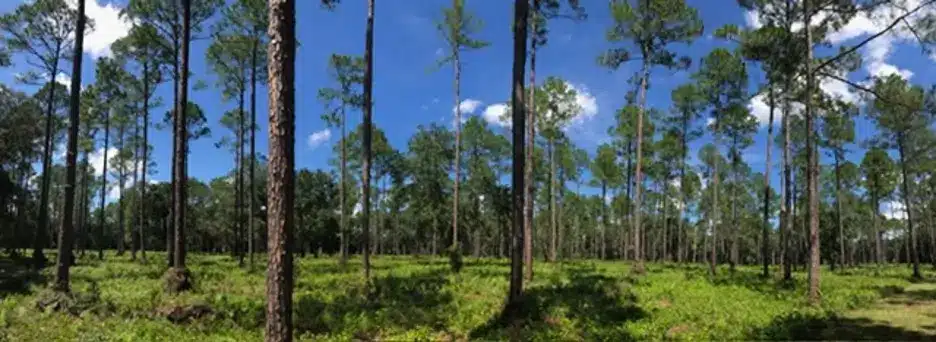
Colonial naturalist, artist, and author William Bartram and his father, John, first explored this area in 1765–66. They were inventorying plants and seeking the source(s) of the St. Johns River. Billy returned in 1774 on a mission to identify, describe, and document plants, animals, and native peoples he encountered along the way. In his journal, he mentions vast pine savannah forests. He wrote vivid descriptions of “open airy groves of the superb turpentine pines” and recorded how indigenous communities chewed the resin of the turpentine-producing trees to sweeten their breath.
Billy’s observations focused on these iconic trees, primarily the Longleaf Pine (Pinus palustris), and the local environs. He observed the seemingly endless, fire-swept pine barrens of the coastal plain, noting the natural beauty and ecological resilience of these turpentine-producing pine forests.
His accounts effectively captured these distinct longleaf pine habitats before they were completely altered by intense human exploitation. The trees Bartram recorded were of immense economic importance during the colonial, Revolutionary, and industrial eras.
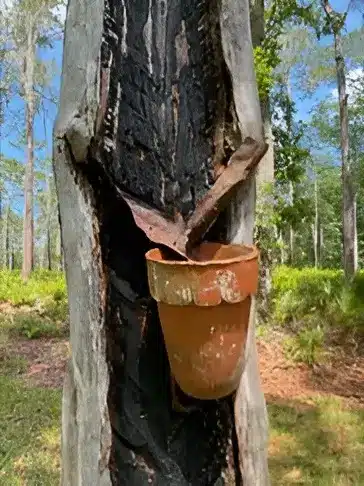
The resin, or thick sap, oozing from these pines was harvested to manufacture tar, pitch, and turpentine. Called “naval stores,” these chemical byproducts were essential for caulking the joints of wooden ships, waterproofing ropes, and preserving maritime hardware.
In his book, “Travels,” Billy also noted the unique hydrology and geology of the regions where these pines grew. Modern science confirms his observations, noting that the “turpentine pine” is highly fire-tolerant and uses its thick sap to naturally repel invading insects. Bartram’s records served as a critical historical baseline. In later centuries, millions of acres of these longleaf pine forests were systematically “bled” for the turpentine industry, leaving behind scarred tree stumps (known as cat-faces) across the Southern landscape. Around 1904, University of Georgia chemist Dr. Charles Herty invented a clay cup to efficiently collect the resin. Today, conservationists and land managers frequently reference Bartram’s detailed ecological descriptions in Travels.
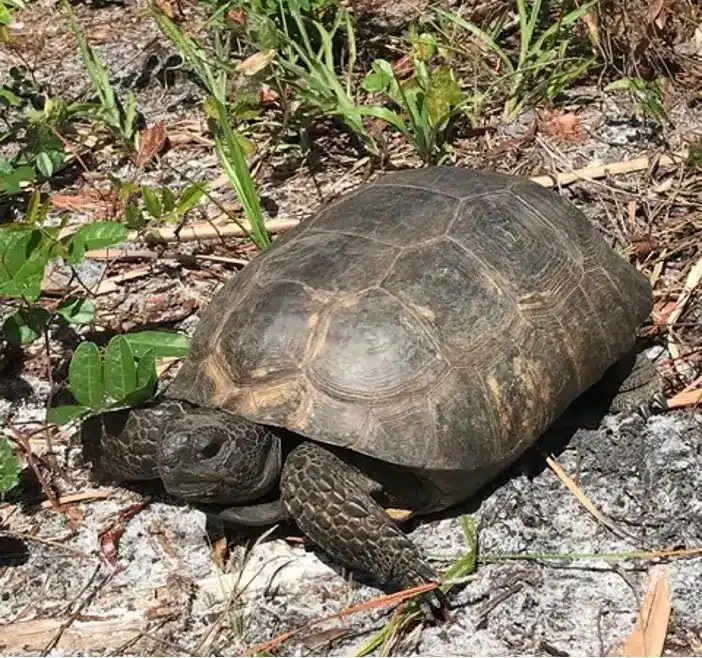
The gopher tortoise (Gopherus polyphemus) is a keystone species indicating high-quality pine forest health.
All photos by Mike Adams at Saturiwa Conservancy
Owned and managed by Mike and Carole Adams