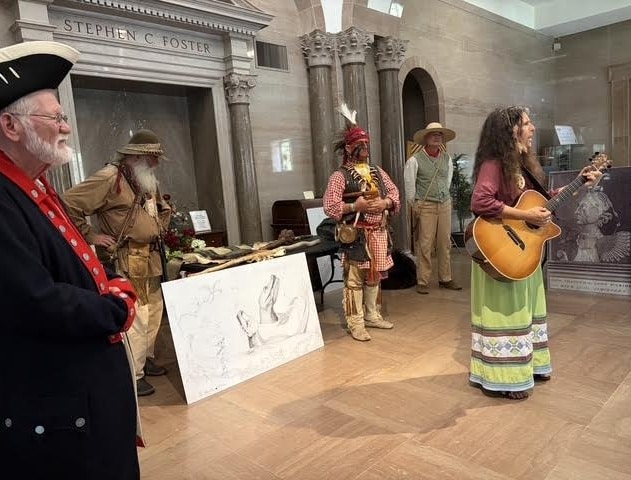
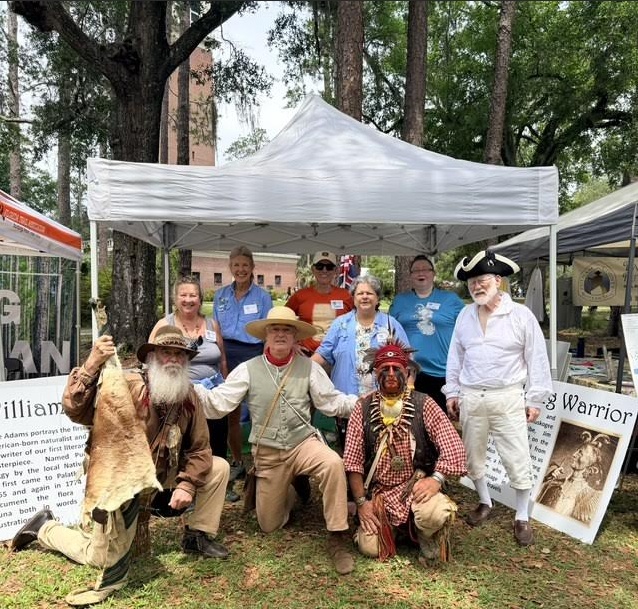
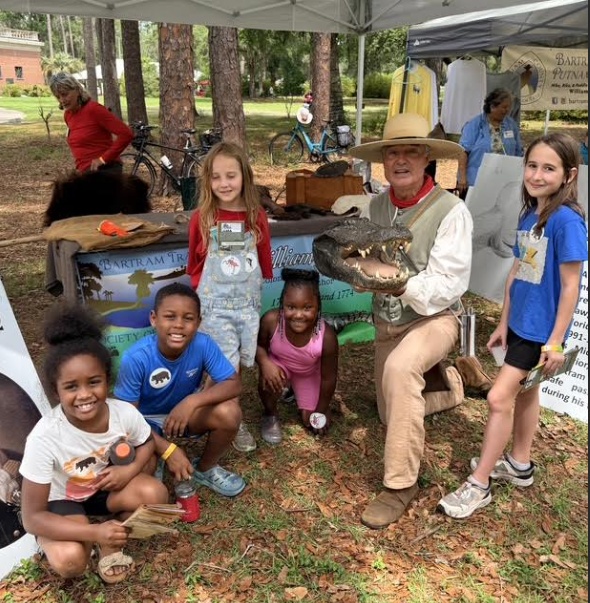
Over Memorial Day weekend, the Bartram Trail Society of Florida participated in its sixth consecutive Florida Folk Festival. Our participation was made possible by the leadership and guidance of Society president Sam Carr.
This year was the 74th annual festival at Stephen Foster Cultural Center and State Park in White Springs. Our Society’s living history crew and Bartram troubadour, Harri Buffalo, with Lee Pinkerson and Bill Snyder, performed six presentations, celebrating America’s 250th anniversary. Along with Billy Bartram (Mike Adams), Job Wiggins (Robert Wilson), Seminole Chief Ahaya, the Cowkeeper (Jim Sawgrass), were Colonel Lachlan McIntosh (Sam Carr), and two of Sam’s grandchildren, a British Loyalist soldier (Marshall Pilger) and an American Continental soldier (Lorelie Pilger).
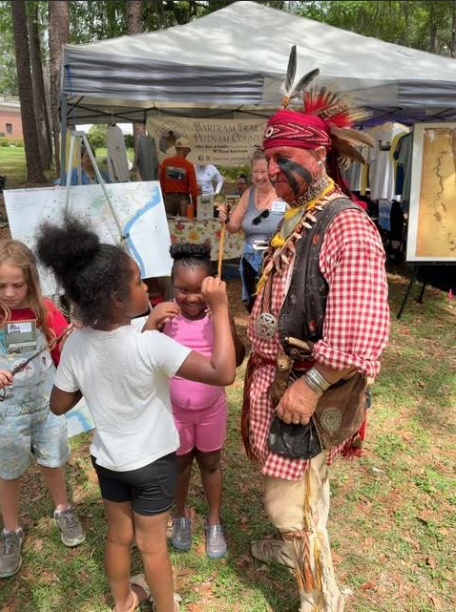
The reenactment depicted a July 2, 1776 skirmish at the St. Mary’s River, the boundary between the Georgia colony and the East Florida territory. The British Loyalists and a band of Seminole warriors, led by Chief Ahaya, marched up from St. Augustine, following orders from then Governor Patrick Tonyn. This battle party hunkered down at an abandoned trading house on the south bank. The Georgia Continental Militia, led from Colonel McIntosh’s plantation north of Darien, accompanied by Billy Bartram, was hidden amongst the cypress trees on the north bank. Musket fire soon commenced from both sides.
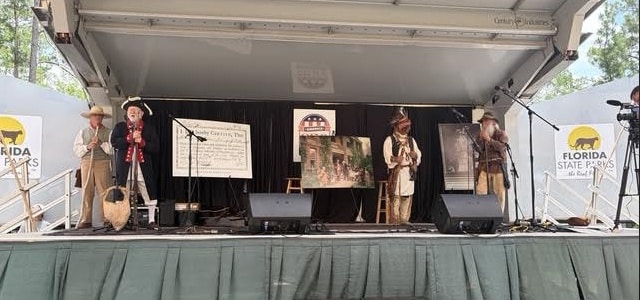
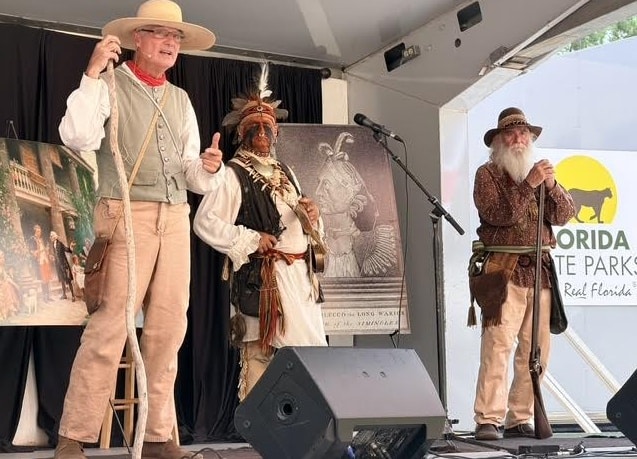
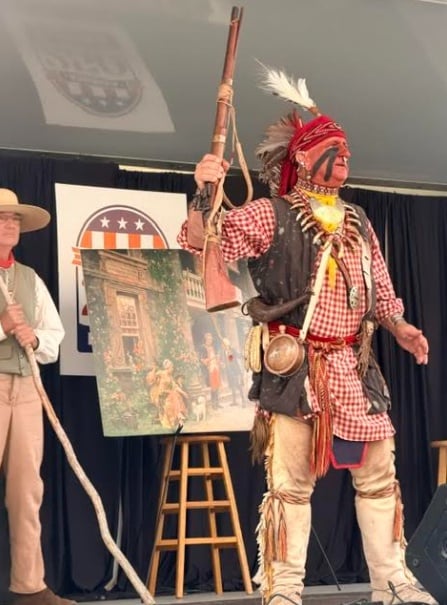
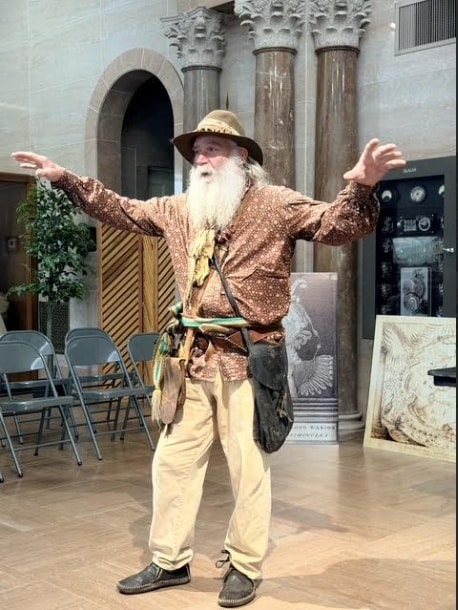
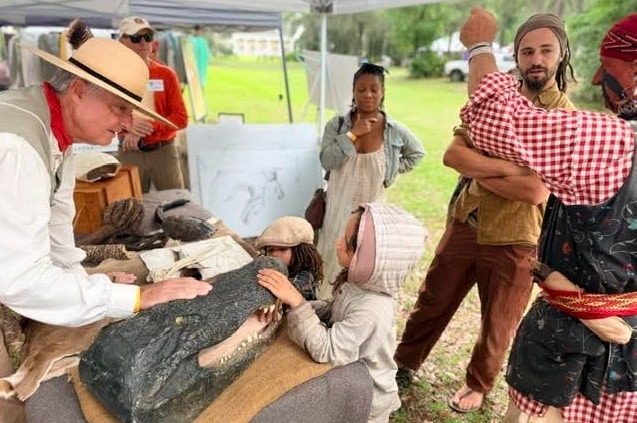
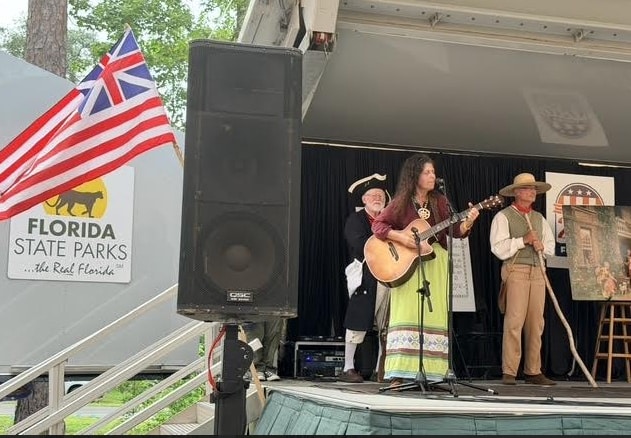
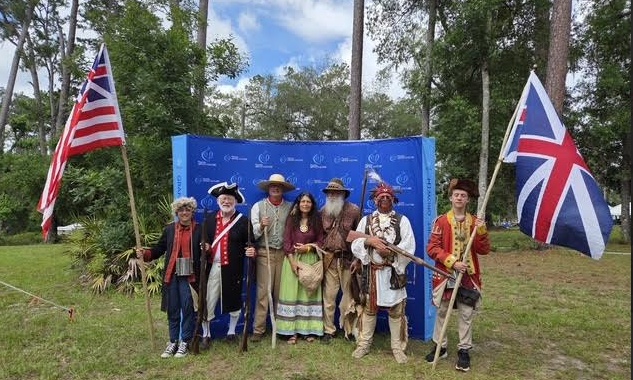
Chief Ahaya suddenly recognized his longtime friend Billy, whom he named “Puc-puggy, the flower hunter,” two years earlier, at his village of Cuscowilla, along the Great Alachua Savannah, now Paynes Prairie Preserve and State Park, near present-day Gainesville. The Chief “threw down his gun and boldly stepped out from cover, amidst a shower of bullets,” and threw up his headdress, “whirling it in the air.” He shouted, “Stop firing; there is no need for bloodshed on this day.” After he bravely diffused the battle, he then gathered his warriors and departed to the south. After this incident, Billy was offered a lieutenant’s commission in the George Militia. Because of his pacifist Quaker background, deep Spirituality and conscience, and a love for the natural world, humanity, and peace, he declined the promotion to such military service during this tumultuous time.
Later in September of 1776, after this early skirmish in the American Revolution, realizing the dangers of war, Billy ended his southeastern colonial explorations. He returned to the safe confines of his father, John’s herbarium and gardens outside Philadelphia.
During the next ten years, Bartram’s peaceful gardens along the banks of the Schuylkill River outside Philadelphia evolved into an important place of respite and a retreat for our founding fathers. The budding new American leadership would meet there and discuss the new union of colonies’ independence. Billy eventually published his famous book Travels in 1791.
For more about the Bartrams and the Founding Fathers, see an earlier blog on this website, William Bartram’s Role in Our Constitution by Sam Carr.