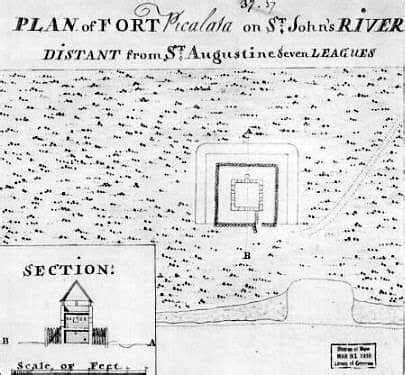
Fort Picolata (Spanish: Fuerte Picolato) was an 18th-century Spanish fort on the east bank of the St. Johns River, in northeast Florida. It was about eighteen miles west of St. Augustine (the capital of Spanish Florida), lying on the old trail known as “El Camino Real” to the Spanish province of Apalachee in western Florida. Fort Picolata and its sister outpost, Fort San Francisco de Pupo (built on the river’s west bank sometime before 1737), controlled all traffic at the ferry crossing where the river is comparatively and strategically narrow. This natural pass was called “Salamatoto” by the Indians. The first defense works at the site (built soon after 1700 as an outpost of the military defensive network of St. Augustine) were little more than a wooden sentry box surrounded by a timber palisade.
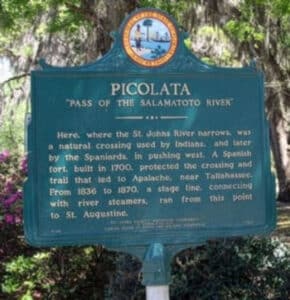
When General James Oglethorpe (the governor of the British Province of Georgia) invaded the East Florida Territory in late December 1739 and early January 1740 with his force of Scottish Highlanders and Indian allies, the Indians captured and burned Fort Picolata. Oglethorpe then laid siege to St. Augustine. The Spanish rebuilt the fort in 1755 using native coquina blocks, quarried on Anastasia Island east of St. Augustine. Coquina is a native fossilized, small fragments of shells, compressed with fine sand. It is well adapted to the construction of fortifications. It lay in horizontal formations in the quarry and constituted the geological foundation of Anastasia Island. The “castle” (now Castillo De San Marcos) at the St. Augustine bayfront, and most of the period buildings of the town, were built using this local native stone.
This rebuilt fort was a square tower thirty feet high, invested with a high wall without bastions, about breast-high, pierced with loopholes for muskets, and surrounded by a deep ditch and an earthen berm. The upper story was open on each side, with battlements supporting a cupola. These battlements were formerly mounted with eight four-pound cannons, two on each side.
When the British acquired East Florida following the 1763 Treaty of Paris, they soon recognized the value of Fort Picolata as part of the defenses of St. Augustine. They continued to maintain a garrison there as the Spanish had done. Important congresses between British colonial officials and the Indians took place at Picolata in 1765 and 1767. In November 1765, after riding a day by horseback from St. Augustine, John Bartram and his son Billy attended the first Indian Congress held with British officials in East Florida. Father and son slept inside the fort chamber that night.
John Bartram wrote in his journal that fort structural details included the swivel cannons, magazine, provisions, and kitchen all within the stockade. The fort and surrounding elevated berm, earthworks, and moat were within 40 yards of a bay of the St. Johns River.
On the 18th of November, 1765, about fifty Creek Chiefs met with Governor Grant and Superintendent John Stuart outside the fort. An open pavilion of pine logs covered by pine boughs had been prepared, essentially two poles wrapped around with blankets for the Chiefs to sit upon. Grant and Stuart were seated at a table that faced the Chiefs and the open end of the pavilion.
Paraphrased from John Bartram’s journal entries, after several minutes of ceremonial pomp and circumstances, trading of deer skins, medallions, dances and speeches, the Indians and the British could not agree on the land delineation. On the second day of the congress, the Creeks proposed a treaty for ceding land based on the river tide. The British didn’t accept that demarcation. But Grant and Stuart made alternate proposals. They finally agreed upon a demarcation from the St. Mary’s River to a point in the St. Johns River 60 miles upstream of Ft. Picolata. It proved to be several hundred miles in length.
The agreement was signed, and the governor and Chiefs smoked the pipe of friendship. The Indian Chiefs were each given a large, fine silver medallion. The Indians drummed while the soldiers fired muskets from the fort tower, symbolizing the land treaty. Grant and Stuart shook hands with all the Indian Chiefs. The Fort Picolata Congress concluded on November 19th, where, in addition to the medallions, gifts of muskets, kettles, and blankets were distributed to the Creek Chiefs.
John and Billy stayed in the area for several days, exploring along the river. Many years later, Billy would vividly recall a rattlesnake encounter while attending the congress. While walking in a swamp near the fort, John warned his son to watch out for a monstrous snake coiled up near his feet. Billy instantly cut off a little tree sapling and, in a violent thrashing, soon dispatched this serpent, about six feet in length, and as thick as an ordinary man’s leg. The encounter deterred them from continuing their explorations for the remainder of that day. Billy dragged the snake back to the fort and entered the camp in triumph, and was soon surrounded by the amazed multitude, both Indians and British soldiers.
The incident soon reached the commander, who sent an officer to deliver the snake’s body to the cooks. When invited to dine at the governor’s table that day, the officer saw the snake served in several dishes, Governor Grant being fond of the flesh of the rattlesnake. Billy tasted it but could not swallow it. He was sorry after killing the serpent when, coolly recollecting every circumstance, the snake had certainly had it in his power to kill him almost instantly. With great veneration of nature, Billy promised himself that he would never again be accessory to the death of a rattlesnake.
When Billy returned to East Florida and the St. Johns River in the spring of 1774, he reported that Fort Picolata was dismantled and abandoned. Today, a visitor or curious explorer can see the approximate location of the fort at the intersection of CR 208 and CR 13 South in rural St. Johns County. Given the ever-changing river shoreline, local historians and county officials believe the fort site is located in the river’s shallows.
Mike Adams is a naturalist, educator, researcher, and author. He has lived and worked along the St. Johns River in northeast Florida since 1980. He also serves in the Bartram Trail Society of Florida, headquartered in Palatka.
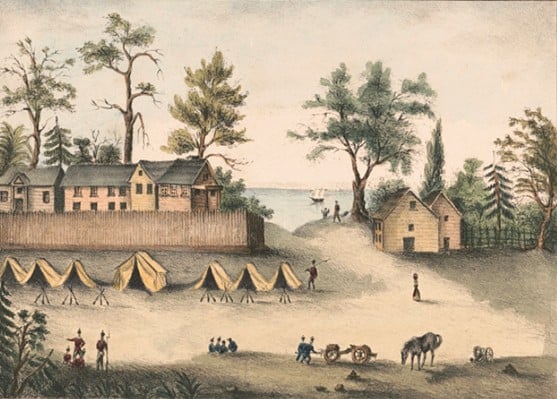
Second Seminole War from 1835 to 1842
T.F. Gray and James, Charleston, S.C., 1837
(Site interpretation artistically enhanced)